
Note: This report focuses on cap rates and market trends for the Greater Vancouver area. The Chilliwack commercial real estate market tends to follow similar trends due to regional economic influences, investor activity, and tenant demand. While specific local variations exist, the insights provided here are generally applicable to Chilliwack as well.
Industrial, Retail, and Office Breakdown
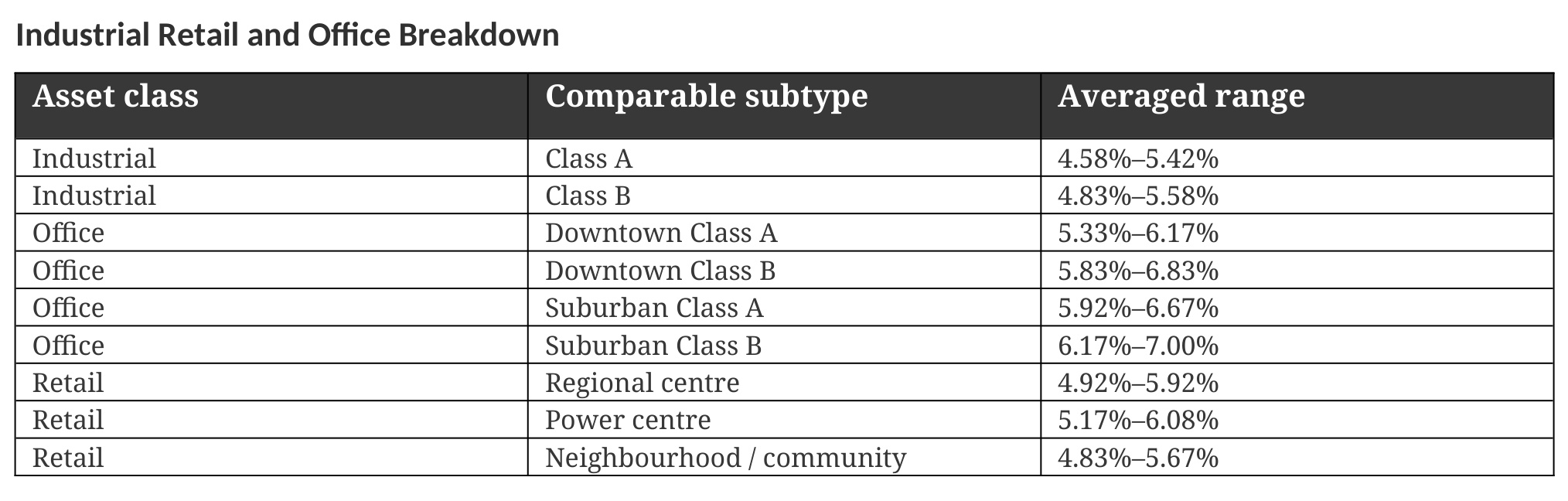
Q3 2026 Cap Rate Snapshot:
Cap rates across the Vancouver benchmarks were largely stable in Q3, even as the five-year Government of Canada bond yield climbed from 3.01% at the end of June to 3.69% on September 29. The averaged Class A industrial range was 4.58%–5.42%, compared with 5.33%–6.17% for downtown Class A office. Investors continue to distinguish between dependable, well-leased properties and assets that need leasing or capital work. Higher bond yields add pressure to that distinction, even where published cap-rate ranges have yet to move materially.
Industrial
Industrial remains one of the tighter segments in the regional market. A Greater Vancouver survey put vacancy at 2.7%, down 40 basis points from Q2, with availability at 3.8%.
Leasing activity was concentrated in bays under 30,000 square feet, underscoring the appeal of functional smaller spaces.
A separate Metro Vancouver survey reported 5.0% industrial vacancy. The two firms report different rates for the region, so these figures should be treated as separate survey measures rather than directly comparable readings.
Office
Office continues to show a wider divide by building quality. A Vancouver survey reported 12.2% vacancy in the Downtown Core and 7.9% in the suburbs in Q3.
Within that Downtown Core, combined Class AAA/A vacancy was 9.1%, down 10 basis points from Q2. New supply and larger listings lifted suburban vacancy.
Modern Class A space is better positioned to retain tenants. Older Class B properties may require more leasing time and capital spending, which buyers will reflect in pricing.
Retail
Retail demand continues to favour centres supported by everyday shopping and reliable tenants.
A Shoppers Drug Mart anchored centre in Delta sold for $18.2 million, illustrating the appeal of established income in this segment.
A mid-year Vancouver-area measure put grocery-anchored retail vacancy at just 0.65%.
That regional strength is encouraging, but a smaller Chilliwack property still depends on its own location, lease terms and tenant mix.
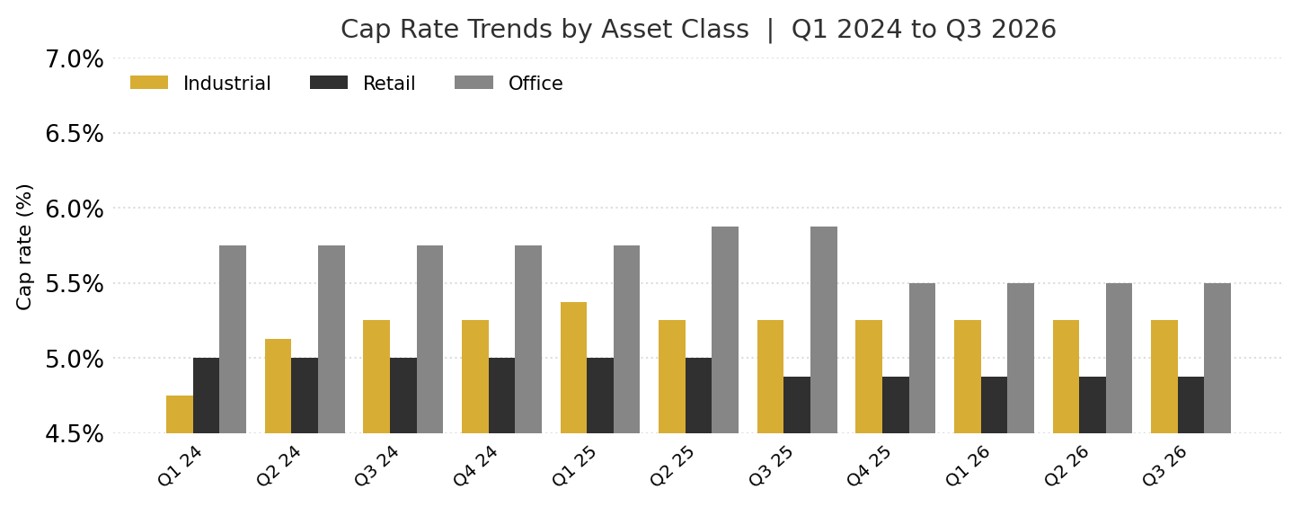
Buyer and Seller Activity
Private investors and owner-users remained engaged in Q3, but the rise in bond yields made pricing and financing more important to a purchase decision. Interest was strongest in properties where the income could be understood and the near-term costs were clear. A long lease and a dependable tenant helped buyers assess value; vacancy, major repairs and tenant improvements required more room in the numbers. For owner-users, the usefulness of the space to their business remained an important consideration alongside investment yield.
Sellers of well-leased properties were in a stronger position to support their asking prices with current leases and operating records. Where a building needed work or had space to fill, buyers were more likely to negotiate price or terms to account for that risk. Activity remains selective rather than broad-based: the same regional cap-rate benchmark can produce different outcomes for two Chilliwack properties with different income, location or building quality.
Cap Rates vs. Canadian Bond Yields
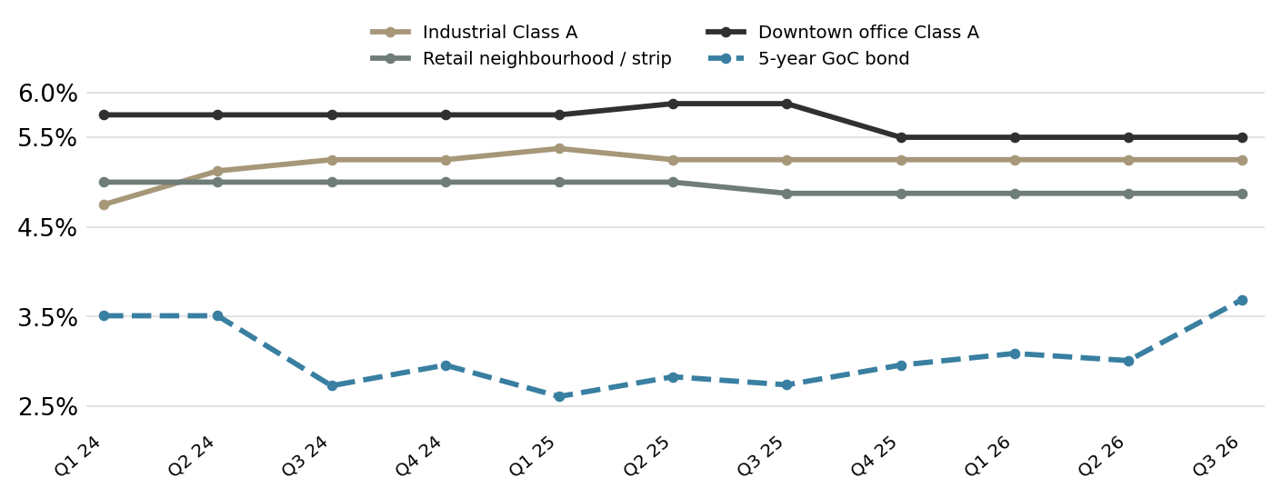
The five-year Government of Canada bond yield closed Q3 at 3.69% on September 29, up from 3.01% at the end of Q2. Published cap-rate benchmarks did not rise at the same pace. That has narrowed the gap between the government bond yield and property yields, making lease security and the cost of future improvements more important to investors. The chart tracks the bond yield and consistent Vancouver industrial, retail and office benchmarks each quarter since Q1 2024.
Conclusion
The Q3 picture is one of stable published cap rates and more selective underwriting. Industrial benefited from tight regional space conditions, retail from demand for dependable income, and office performance continued to depend heavily on building quality. The Bank of Canada raised its policy rate to 2.50% on October 28, after the quarter closed; that rate is separate from the five-year bond yield in the chart. In Chilliwack, Vancouver benchmarks provide useful direction, but local transactions, the strength of the leases and the work a building needs will determine what buyers are prepared to pay. Sellers with complete income and expense records will be better placed to make their case.
Disclosure
This report is based on information obtained from multiple third-party sources, including Colliers, CBRE, Cushman & Wakefield, Avison Young, and Altus Group. The data presented is intended for informational purposes only and should not be solely relied upon for investment decisions. Cap rates and market conditions may vary based on specific locations, asset conditions, and economic factors. For personalized investment advice, consult with a commercial real estate professional.
 The data relating to real estate on this website comes in part from the MLS® Reciprocity program of either the Greater Vancouver REALTORS® (GVR), the Fraser Valley Real Estate Board (FVREB) or the Chilliwack and District Real Estate Board (CADREB). Real estate listings held by participating real estate firms are marked with the MLS® logo and detailed information about the listing includes the name of the listing agent. This representation is based in whole or part on data generated by either the GVR, the FVREB or the CADREB which assumes no responsibility for its accuracy. The materials contained on this page may not be reproduced without the express written consent of either the GVR, the FVREB or the CADREB.